
(All this week I’m going to be posting about bpNichol, because I love bpNichol)
From the biography of bpNichol at the Online bpNichol Archive
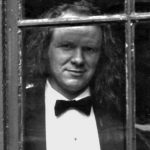
bpNichol (Barrie Phillip Nichol) was born September 30, 1944 in Vancouver, British Columbia. His writing is, by definition, engaged with what he called “borderblur”: in his lifetime he wrote (somewhere between) poetry, novels, short fiction, children’s books, musical scores, comic book art, collage/assemblage, and computer texts. Nichol was also an inveterate collaborator, working with the sound poetry ensemble The Four Horsemen (whose members were Nichol, Rafael Barreto-Rivera, Paul Dutton, and Steve McCaffery); Steve McCaffery as part of the Toronto Research Group (TRG); the visual artist Barbara Caruso; and countless other writers.
In the mid 1980s bpNichol became a successful writer for the children’s television show Fraggle Rock, produced by Jim Henson. His early work in sound was documented in Michael Ondaatje’s film Sons of Captain Poetry. A second film has been made on Nichol, bp: pushing the boundaries, directed by Brian Nash; he also appears in Ron Mann’s film Poetry in Motion.
bpNichol died in Toronto, Ontario on September 25, 1988.
bpNichol’s poetry could be said to be obsessed with language, or more than that, communication beyond language. This might be best summed up by his poem Landscape I:
alongthehorizongrewanunbrokenlineoftrees
We create meaning by making distinctions: I know that this poem reads ‘along the horizon grew an unbroken line of trees’ because I know how to separate the sounds that way. But why should the characters signify those sounds? Am I able to see any other ways of interpreting the line? The word ‘unbroken’ is very significant here—we (must) break this line to create civilisation, and the poem questions this process of creation.
For bpNichol (as it was for cummings) the visual appearance of a poem was inextricable from it’s tone, meaning; reading.
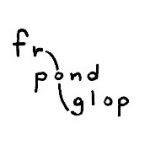
Nichol was obsessed with the possibilities of language but also possibilities in general (see his endless variations of poems and other art), and what exactly we lose and gain by making various choices. This can lead his work to heady grounds (Nichol was a ‘pataphysicist, something which I barely understand the wiki summary of) but at the same time his childlike joy in letters and language makes his poetry very human and accessible, like the “translation” of Basho’s “frog haiku” at the top of the post. His “magnum opus”, The Martyrology is an epic 9-book, “unending, never beginning” stream-of-consciousness ride through Nichol’s life, something which sounds off-putting but Nichol’s self-conscious, self-deprecating—and more importantly, kindness and humourous—persona means it can survive the occasional obscurities. When Nichol writes:
it will make sense yet
this blue & green
these fragmentary lives & conversations
& the white world, saints’ homes, in betweenwe know that it refers not just to his own life, but also an admission that his efforts to understand it might not actually help us to understand it; Nichol repeatedly plays on the issues of reading, writing and textuality: The Martyrology itself was being “constantly written.”
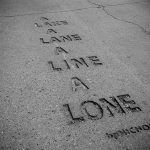
The photo at the top of the post is a poem of bpNichol’s engraved into bpNichol lane, a road running alongside Coach House Press in Toronto, a publishing house that bpNichol was deeply connected with. (A Coach House employee re-waters the word LAKE every day).
(I will probably not cover Nichol’s sound work, so here is a link to some of it: http://www.writing.upenn.edu/pennsound/x/Nichol.php)