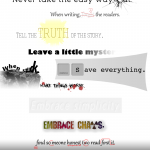
Over-booked

Ugh. I made the mistake of buying an incredibly practical guide to fleshing out a basic story, and now I’m doing it to a couple of my other ideas that I really like, such as The Myses (yes, I’ve settled on one S). I LOVE the characters. it’s awful how quickly I get attached these days.

Too…many…ideas…

60 Awesome Search Engines for Serious Writers

Finding the information you need as a writer shouldn’t be a chore. Luckily, there are plenty of search engines out there that are designed to help you at any stage of the process, from coming up with great ideas to finding a publisher to get your work into print. Both writers still in college and those on their way to professional success will appreciate this list of useful search applications that are great from making writing a little easier and more efficient.

Professional

Find other writers, publishers and ways to market your work through these searchable databases and search engines.

  1. Litscene: Use this search engine to search through thousands of writers and literary projects, and add your own as well.
  2. Thinkers.net: Get a boost in your creativity with some assistance from this site.
  3. PoeWar: Whether you need help with your career or your writing, this site is full of great searchable articles.
  4. Publisher’s Catalogues: Try out this site to search through the catalogs and names of thousands of publishers.
  5. Edit Red: Through this site you can showcase your own work and search through work by others, as well as find helpful FAQ’s on writing.
  6. Writersdock: Search through this site for help with your writing, find jobs and join other writers in discussions.
  7. PoetrySoup: If you want to find some inspirational poetry, this site is a great resource.
  8. Booksie.com: Here, you can search through a wide range of self-published books.
  9. One Stop Write Shop: Use this tool to search through the writings of hundreds of other amateur writers.
  10. Writer’s Cafe: Check out this online writer’s forum to find and share creative works.
  11. Literary Marketplace: Need to know something about the publishing industry? Use this search tool to find the information you need now.

Writing

These helpful tools will help you along in the writing process.

  1. WriteSearch: This search engine focuses exclusively on sites devoted to reading and writing to deliver its results.
  2. The Burry Man Writers Center: Find a wealth of writing resources on this searchable site.
  3. Writing.com: This fully-featured site makes it possible to find information both fun and serious about the craft of writing.
  4. Purdue OWL: Need a little instruction on your writing? This tool from Purdue University can help.
  5. Writing Forums: Search through these writing forums to find answers to your writing issues.

Research

Try out these tools to get your writing research done in a snap.

  1. Google Scholar: With this specialized search engine from Google, you’ll only get reliable, academic results for your searches.
  2. WorldCat: If you need a book from the library, try out this tool. It’ll search and find the closest location.
  3. Scirus: Find great scientific articles and publications through this search engine.
  4. OpenLibrary: If you don’t have time to run to a brick-and-mortar library, this online tool can still help you find books you can use.
  5. Online Journals Search Engine: Try out this search engine to find free online journal articles.
  6. All Academic: This search engine focuses on returning highly academic, reliable resources.
  7. LOC Ask a Librarian: Search through the questions on this site to find helpful answers about the holdings at the Library of Congress.
  8. Encylcopedia.com: This search engine can help you find basic encyclopedia articles.
  9. Clusty: If you’re searching for a topic to write on, this search engine with clustered results can help get your creative juices flowing.
  10. Intute: Here you’ll find a British search engine that delivers carefully chosen results from academia.
  11. AllExperts: Have a question? Ask the experts on this site or search through the existing answers.

Reference

Need to look up a quote or a fact? These search tools make it simple.

  1. Writer’s Web Search Engine: This search engine is a great place to find reference information on how to write well.
  2. Bloomsbury Magazine Research Centre: You’ll find numerous resources on publications, authors and more through this search engine.
  3. Merriam-Webster Dictionary and Thesaurus: Make sure you’re using words correctly and can come up with alternatives with the help of this tool.
  4. References.net: Find all the reference material you could ever need through this search engine.
  5. Quotes.net: If you need a quote, try searching for one by topic or by author on this site.
  6. Literary Encyclopedia: Look up any famous book or author in this search tool.
  7. Acronym Finder: Not sure what a particular acronym means? Look it up here.
  8. Bartleby: Through Bartleby, you can find a wide range of quotes from famous thinkers, writers and celebrities.
  9. Wikipedia.com: Just about anything and everything you could want to look up is found on this site.
  10. Stanford Encyclopedia of Philosophy: Find all the great philosophers you could want to reference in this online tool.

Niche Writers

If you’re focusing on writing in a particular niche, these tools can be a big help.

  1. PubGene: Those working in sci-fi or medical writing will appreciate this database of genes, biological terms and organisms.
  2. GoPubMd: You’ll find all kinds of science and medical search results here.
  3. Jayde: Looking for a business? Try out this search tool.
  4. Zibb: No matter what kind of business you need to find out more about, this tool will find the information.
  5. TechWeb: Do a little tech research using this news site and search engine.
  6. Google Trends: Try out this tool to find out what people are talking about.
  7. Godchecker: Doing a little work on ancient gods and goddesses? This tool can help you make sure you have your information straight.
  8. Healia: Find a wide range of health topics and information by using this site.
  9. Sci-Fi Search: Those working on sci-fi can search through relevant sites to make sure their ideas are original.

Books

Find your own work and inspirational tomes from others by using these search engines.

  1. Literature Classics: This search tool makes it easy to find the free and famous books you want to look through.
  2. InLibris: This search engine provides one of the largest directories of literary resources on the web.
  3. SHARP Web: Using this tool, you can search through the information on the history of reading and publishing.
  4. AllReaders: See what kind of reviews books you admire got with this search engine.
  5. BookFinder: No matter what book you’re looking for you’re bound to find it here.
  6. ReadPrint: Search through this site for access to thousands of free books.
  7. Google Book Search: Search through the content of thousands upon thousands of books here, some of which is free to use.
  8. Indie Store Finder: If you want to support the little guy, this tool makes it simple to find an independent bookseller in your neck of the woods.

Blogging

For web writing, these tools can be a big help.

  1. Technorati: This site makes it possible to search through millions of blogs for both larger topics and individual posts.
  2. Google Blog Search: Using this specialized Google search engine, you can search through the content of blogs all over the web.
  3. Domain Search: Looking for a place to start your own blog? This search tool will let you know what’s out there.
  4. OpinMind: Try out this blog search tool to find opinion focused blogs.
  5. IceRocket: Here you’ll find a real-time blog search engine so you’ll get the latest news and posts out there.
  6. PubSub: This search tool scours sites like Twitter and Friendfeed to find the topics people are talking about most every day.

Also, as an established writer, do you get more say in the cover art of your books? I read somewhere that most writers don’t get much, if any at all, say in what the cover art will be, unless I heard it wrong?

neil-gaiman:

This is the cover of GHASTLY BEYOND BELIEF. It was my first book, in 1984. I was 23. I drew the cover on a napkin in a pub, chatting to Faith Brooker, the editor, and gave it to her to keep, and she passed it to the head of the art department, who gave it to the artist, Alan Craddock, who painted it. And the head of the art department did everything I asked for, even making the word Ghastly green and dripping.

This spoiled me, and because I did not believe after that that writers get no say in their covers, I’ve always had a say in the cover designs since then.

I love Scrivener! I just don’t use it anywhere near as often as I should D: gotta change that.

I just can’t get over how it makes my natural flow of thought work so well! as long as I’ve organized my pages in a way that makes sense when I come back to it, I remember where things are and when one thought begets another, I put it in its proper place.

because especially when worldbuilding for sci-fi or fantasy, it’s easy for designing a train to turn into a case study of the vicious beasts that occasionally hold up the train to the culture of the fearsome thieves who tame those beasts to a plot point where one of those thieves turns on his brothers to how that develops the main character…

and in Scrivener I can just hop from one document to another, attach pictures where visual inspiration is necessary, and piece it all together later with the fantastic organization structure.

EEEEE okay. I could nerd out about this all day.

A little of anxiety

My Scrivener file is such a big lovely tumble of folders and pictures, but there’s one that puts a knot in my stomach whenever I look at it: the “publishing” folder. Yikes. That’s the hardest stuff to think about right now. I’m looking so forward to the writing process that I keep thinking I can avoid that other part. Nope. Time to be a grown-up writer.

interestingish writing exercise below cut.

I have been tempted to scenify by my intriguing prompt book, “The 3 A.M. Epiphany.”  this particular one was to describe a scene through synesthasia, which is handy because I happen to have a character who can taste sound. so, p. weird, and I apologize if I have misrepresented what this condition would be like, please educate me otherwise if it is wrong because I want to get this right!

onward.

I awaken to the gentle honey of a perfect sunrise.  The neurowalls lift daylight around me.  I tense each muscle down my abdomen until I pull myself up with infinite slowness.  When I am sitting straight, the morning is fully upon my room.

A tinkle tasting of wild oats lures me to the kitchen without a robe.  I pour a glass of water first and stand at the sink, watching the apple tree out my window.  Two birds flicker from branch to branch.  “Sound up,” I say, my own voice cuing a distant ocean in my throat, and the window thins to let the birdsong in.

They sweeten the morning like lemon butter as I slide to the sink and turn on the water.  Oats sift headily into the metal pot, followed by the water, a bit bitter.  Stirring with a wooden spoon produces a complimenting flavor.  The salt is silent, or at least I can’t hear it when I add my orange whistle to the birds’.

I rest my hand against the panelulum and set it swinging.  A tasteless, odorless voice leaks through the walls as I move into the bathroom.  “You have two messages.  One is from Lhaleen.  One is from Hesh.”

I turn on the water and pinch off two mint leaves from the plant beside the sink.  The mirror ripples and displays the house avatar: an equally bland face to match the voice.  “Would you like me to read your messages?”

“Open Lhaleen’s.”  Her name is like a young wine.  I rub the mint into my skin.

“Of course.”  The avatar ripples away and I can see my face again.  I scritch away the hazelnutty hairs with a sharpened blade and rinse them away while the voice reads.

“Tamlin comma.  I’m feeling awfully bloaty and need a good workout.  I’m in town for a few, want to catch the tube to the gym?  Yours comma.  Lhaleen.”

I put toothpaste to my tongue.  “She’s so charming.  Say yes, but blunt enough that she’s worried when she gets here.”

The avatar withdraws completely from the mirror to back to its servers and think.  Meanwhile, I dab my face dry and go for the soft dayrobe hung on the bathroom door.  It settles onto my skin with a soft blueberry sigh.

I left the window open, and the birds chatter at each other over their nestbuilding—a domestic dispute, nettles and thyme.  My oatmeal bubbles on the stove and eagerly quicksands the brown sugar I sprinkle over the top.  The water is almost absorbed, voicing wet-rag anger at its assimilation.

A playful spring breeze wafts through the window, tickling the edges of my dayrobe.  I pull the fabric closer and pour a glass of milk, anticipating the sweet fat at the sound.  Milk: the first taste of life, one of the few material things that rings true across the senses.  Milk is milk is milk.  It tastes like security, smells like it, looks like it (solid and present).

Adventures in Scrivener

I’ve finally gotten into Scrivener!  I’ve now set up my entire universe, including character cards, pictures I’ve saved for reference and inspiration, and all my notes from various devices.  I can’t believe I haven’t used this software before. UGH. it’s incredible. it has every feature you never knew you absolutely needed.

my inner organizationy self is so giddy right now. and I can still use my little panda flash drive to transport my projects. YAY.

Collaboration

I’m not un-artistic. I’ve got a pretty good eye for colors and a decent sense of taste in fashion and interior decorating (at least, no one recoiled in horror from most of my living spaces, so I’m calling it a victory. small victories. yes). but I don’t have the time or inclination to get good at it. I knew a long time ago that someday I was going to have to find myself a willing artist/victim/collaborator if I wanted to render my wild, colorful ideas.

so along comes this man with whom I fall irreversibly in love. we buy an iPad. he starts sketching. we get married. he starts doing 3-D art and practices at least ten hours a week at drawing, painting, and sculpting digitally.

suddenly…I have my artist.

I’ve made it clear that my dearest has no obligation whatsoever to indulge my silliness and brainstorming kicks, but he seems to love it. he’s been designing me space fighters, bubble cities, ornate weapons, and alien species. almost every day, he asks me what I want to see him draw, or what he can model for me.

some time I’ll write separately about watching his transformation from frustration with a pencil to innate confidence with a stylus. that journey, in and of itself, is going to make for some inspirational material. for now: he’s mine and he’s talented and even if neither of us ever make a dime off our work (too late, for both), we can play in our shared sandbox for the rest of our lives.

<3